Ethical Concerns
PGT-P is a powerful method for embryo selection as it demonstrates a measurable reduction in disease risk. However, it bears wide ethical concerns behind it.
Read the following points for ethical concerns raised for PGT-P.
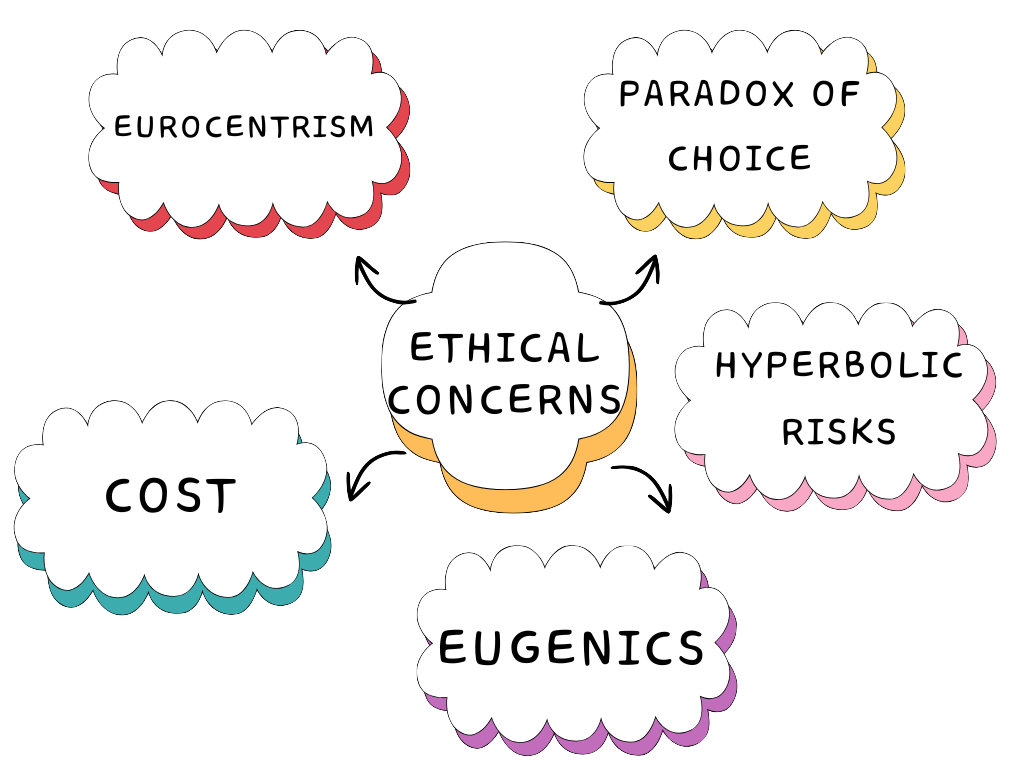
Eurocentrism
Many polygenic risk scores (PRSs) are generated from genomic data sequenced in European populations.
This leads to less accurate PRSs in non-European populations, whereas European populations may benefit from greater success in PGT-P.
Furthermore, results in disparities in healthcare and inaccurate risk predictions among underrepresented (non-European) populations.
Paradox of Choice
The “paradox of choice,” proposed by Barry Schwartz, explains the phenomenon where a person may feel frustrated and dissatisfied when faced with too many choices to make, ultimately leading to avoid making a choice.
Increasing the number of polygenic conditions to screen before embryo implantation may overwhelm parents with too many selections, complicating the decision process.
Hyperbolic Risks
The severity of a disease is not the same across different individuals, therefore a high PRS may only mean a small increase in absolute risk. For example, out of all cases with an increased PRS of schizophrenia, only 5% of it actually occurs.
This may cause panic if there is no effective communication between parents and genetic testing companies.
However, as the severity of the disease lies on a spectrum, it may be difficult for interpretation.
Eugenics
The categorization of certain groups (mental conditions like Schizophrenia and Down Syndrome) are worthy of elimination, also the desirability of certain traits (like intelligence or height).
Threatens genetic diversity and discriminates against certain disabilities.
Cost
The high costs of IVF therapy and PGT may not be covered by insurance, making this an inaccessible service to communities with low socioeconomic status.