
Case Study #1
Family-Specific Polygenic Risk Score
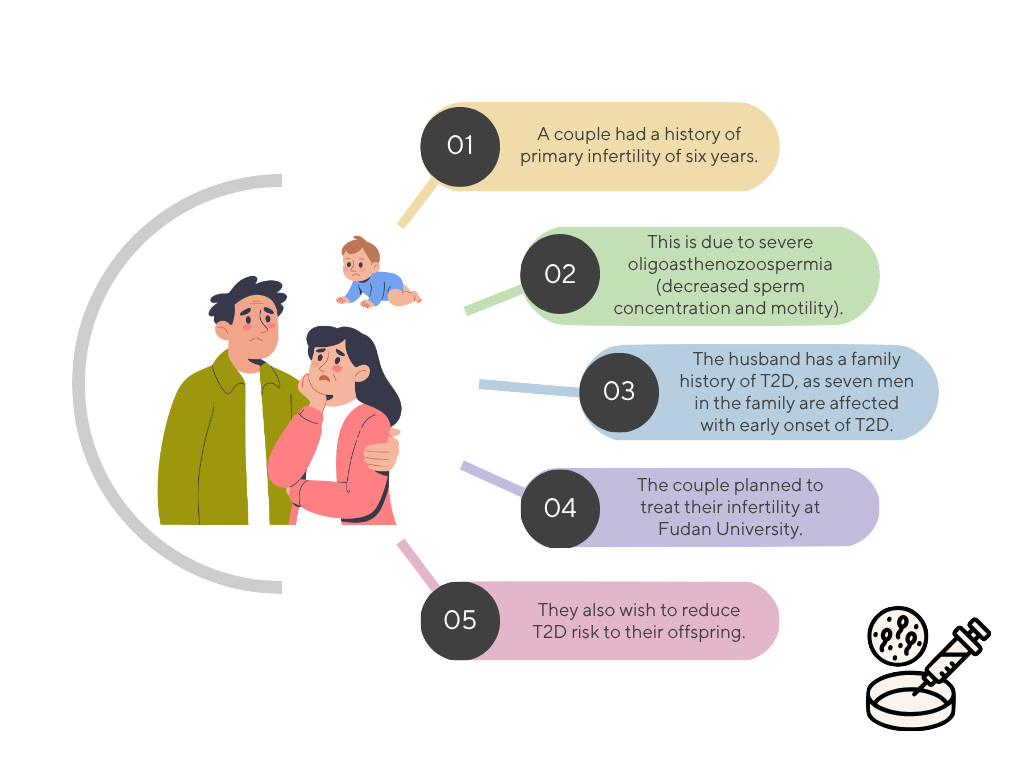
In this study conducted in China, researchers worked with a family that is affected by infertility. With a family history of early onset T2D (Type 2 Diabetes), the couple wished to do IVF and PGT to lower the risk of T2D to their offspring.
The figure below shows a more detailed explanation of the couple’s motivations behind IVF and PGT.
Study Design
As most PRS models are built from samples collected in Europe, this results in more accurate PGT scores among European individuals, creating a disparity for non-European populations. Therefore, researchers of this study aimed to create a family-based polygenic score model that trains on family-based genetics, rather than just on unrelated individuals and the European population.
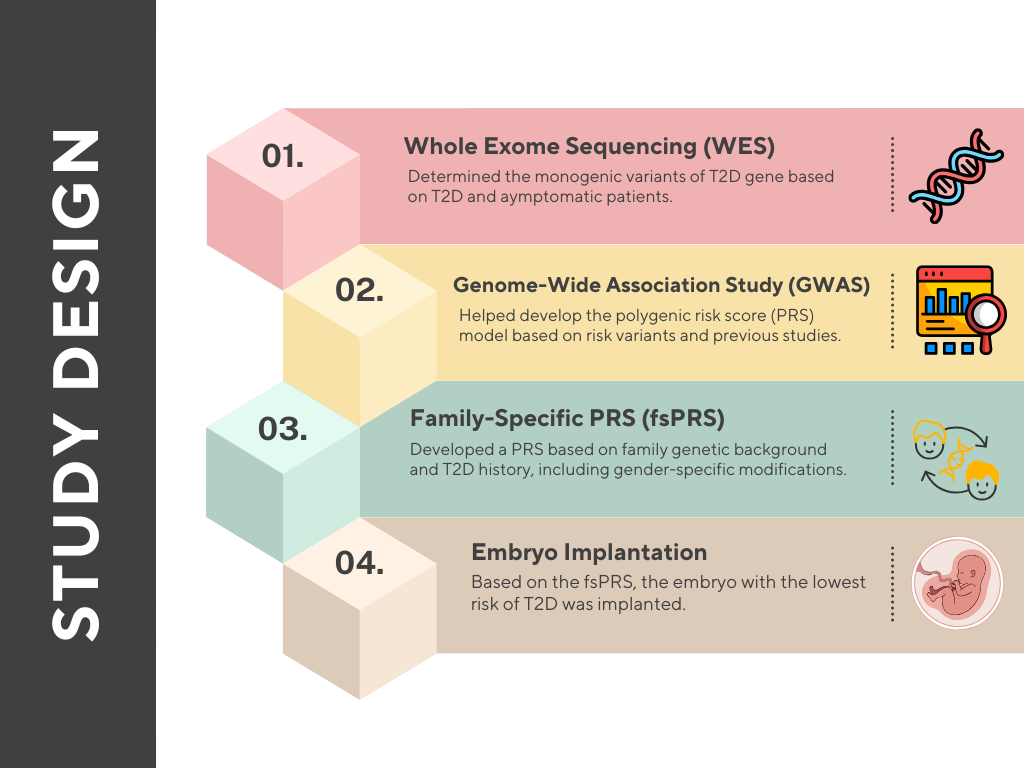
In the experiment design,
- The researchers first performed whole exome sequencing (WES)* on family members affected by T2D. This helped determine genetic variants distinguishing affected (case) and asymptomatic patients (control).
- Then, they analyzed previous genome-wide associated studies (GWAS) to develop a T2D PRS (polygenic risk) model. They identified 27,497 patients and healthy controls to validate the results independently.
- To ensure a more accurate PRS model, the researchers built a family-specific T2D PRS (fsPRS) model based on the T2D family history. As T2D incidence is higher among men, researchers also accounted for gender-specific modifications.
- The embryo with the lowest polygenic risk score for T2D was implanted.
*Whole exome sequencing: sequencing all protein-coding regions of a person’s gene
Results
After a 16-month checkpoint, post-analysis showed the baby to be healthy with normal development.
This confirmed the efficacy of a family-specific PRS in detecting T2D within the family. It also opens the possibility of personalized medicine, where families receive a more precise PRS informed by their family history.
Rather than relying on a general PRS model trained on European populations, this method allows non-European populations to utilize PGT-P more effectively.